1The crate from the south
Far to the south, on an island of white sand and salt-bush, live the quokkas. They are famous for one thing: they smile at everybody. Fletch smiled at everybody too. But while he smiled, he counted the exits.
One summer a trading ship tied up at the island to take on water and figs. Fletch climbed into a crate of dried figs to see what all the fuss was about, ate rather more of them than he meant to, and fell asleep. When the lid came off again he was three moons from home, in a damp green country of oaks and rain, and a carter was shouting at him in an accent he had never heard.
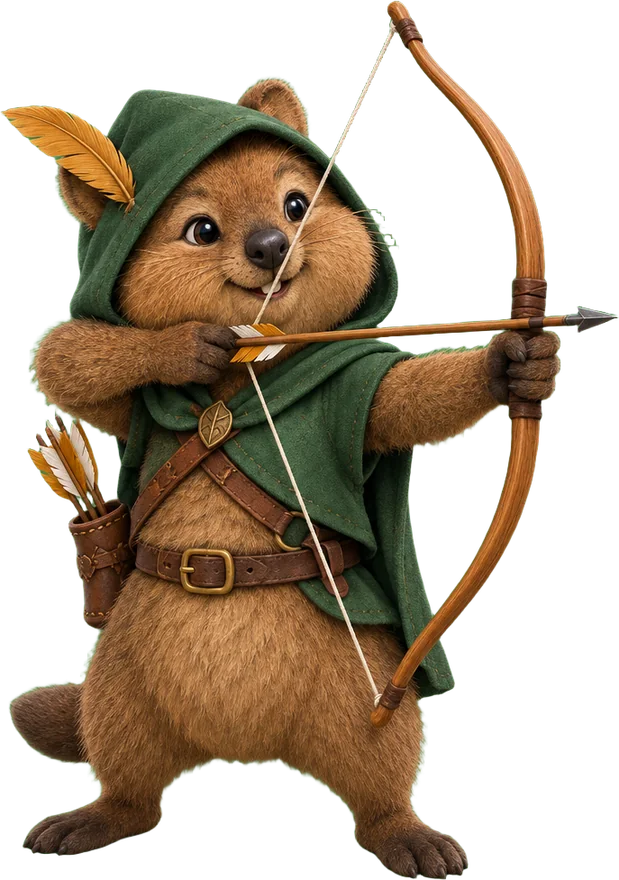
He was cold, he was lost, and he was a very long way from the sea. He was also still smiling. He climbed down from the cart, shook the fig dust out of his fur, and walked into Sherwood Forest.
2The village under the oaks
Deep in Sherwood lay the village of Robinhood, where the forest folk traded at the river market. They didn’t trade grain or cloth. They traded tokens: little carved pieces of wood, each with its own name and its own stall, and a fresh one turned up nearly every hour.
Some tokens were honest work. Some were jokes that everyone was in on. And some, Fletch noticed after a week of sitting quietly on the market wall, were traps. Folk would buy a token at breakfast and by supper find they could not sell it, or that the stall had vanished, or that there were suddenly ten times as many of them as the day before.
The village had a name for the people who set those traps. They called them the Sheriff’s men, though nobody had ever seen the Sheriff.
3The Sheriff’s tricks
Fletch kept a list in the back of his hat. It grew longer every week.
- The Honey Jar. A stall where you could buy as much as you liked, but the jar was built so you could never take your paw back out. You could buy. You could never sell.
- The Baron’s Press. A stall-keeper who kept a printing press in his cellar and turned out new tokens at night, so every token you held was worth a little less each morning.
- The Toll-Gate Men. Stalls with a toll on the way out that the keeper could raise whenever he pleased, all the way to everything you had.
- The Rope-Cutters. Every stall stood on a little rope bridge over the river, and the river was the money you sold into. Some keepers kept a knife on the rope. When the bridge was busiest, they cut it.
- The Riders at the Gate. A band of cloaked riders who were somehow always waiting when a new stall opened its gate, and bought nearly every token in a single breath. Then they sold them to the villagers, a few at a time, for a great deal more.
- The Hidden Cellar. Tokens passed out of the back door to wallets nobody was watching, ready to come back through the front door all at once.
- The Dry Well. A stall whose river had quietly run dry. It still looked open. Nothing could be bought there, and nothing could be sold.
4The old fletcher
At the edge of the village lived Old Wren, who made arrows for the outlaws and asked no questions about where they went. Fletch spent a winter in her workshop, sweeping up shavings and watching.
“An arrow is only as true as its feathers,” she told him. “That’s the fletching. Without it the straightest shaft in Sherwood goes wherever the wind wants.” In spring she gave him a feather the colour of autumn ochre, from a sun-bird that had flown up from the south as he had, and from then on the village called him Fletch.
He made six arrows that spring, and each one asked a single question of any stall in the market:
- Who holds the key to this stall, and can they still change the rules?
- If I buy here, can I really leave with my coin?
- How deep is the river under the bridge, and who holds the knife?
- Who holds the most tokens, and how many of them are there?
- How did the gate open? Were the riders waiting?
- What became of this stall-keeper’s other stalls?
5Four signs of oak
From a fallen oak Fletch carved four signs and hung them on the trails into the market. BOWS UP when his arrows found no traps. EYES OPEN when they found a few things he didn’t love. RISKY when the red flags were real. STAY OUT when a trap was certain.
Under every sign he nailed his reasons, in plain words, so anyone could read them and argue if they liked. Some of the stall-keepers did argue. One offered him a sack of silver to hang a different sign. Fletch smiled at him, the way quokkas do, and hung the same one.
“I’ll tell you the traps,” he told the village. “Whether to buy is your call, mate. Never mine.”
6The night of the twenty-one riders
One grey morning a new stall opened at the river with a fine painted sign and a crowd already round it. Within a breath of the gate opening, twenty-one cloaked riders had bought nearly every token on the table. By noon the price had doubled, and doubled again, and the villagers were queueing.
Fletch did not queue. He followed the riders’ cart into the trees. He watched them sell their tokens back across the river to the villagers, buy them again, sell them again, round and round, until it looked as if half of Sherwood was trading at that stall when it was really twenty-one cloaks and one cart. The stall-keeper, he found out, had arrived in the forest that very week and had no history at all.
He hung RISKY on the trail before supper and wrote it all underneath. Some folk grumbled. The price was going up, they said; what did a quokka know? By the next morning the riders were gone, and the price had gone with them. The villagers who had read the sign still had their coin. A few of the grumblers came to say so, and Fletch only smiled.
7What even Fletch can’t see
Fletch would be the first to tell you that his arrows are not magic. He can follow a trail, but not into a stall-keeper’s heart. A keeper with no traps at all can still sell slowly, a little every day, or tell tall tales at the tavern, or simply walk away. New tricks turn up faster than old ones are found out.
So when a stall gets BOWS UP, it means Fletch found no traps. It has never meant safe, and it has never meant buy.
8The watch
One quokka cannot walk every trail at once, so Fletch set up a notice board at the crossroads where he posts every busy new stall with its sign, refreshed through the day. He hung a bell in the old tower, so any villager can send him a token by messenger and get his answer back. And anyone at all can bring him a stall to check, free, whenever they like.
There is talk in the village of lighting watch fires too: a ranger on every stall you care about, through the night, who rings the bell the moment a rope is cut or a press starts printing. Watch fires need fuel. One day the villagers who want them may feed the fires with a coin of Fletch’s own, half thrown into the flames for good and half kept to buy arrows and oil for the watch.
Until then the board is up, the bell is hung, and the arrows are fletched. If you live in Sherwood, a small ranger in a green hood is watching the trails with you.
9Every forest
Before he left Old Wren’s workshop, Fletch made her a promise. Not to guard one village, or one forest, but to stand between the tricksters and everybody, wherever they trade, on every chain there is.
Sherwood is not the only forest, and Robinhood is not the only village. There are markets on every river in the world, and the Sheriff’s men work all of them. Fletch started in Sherwood because that is where the fig crate landed. He means to keep his promise one forest at a time.
Bows up.
Help Fletch fight dishonesty
Fletch’s fight against the Sheriff’s men runs on goodwill. If you’d like to help keep him on the trails, send ETH or USDC on Robinhood Chain to his wallet:
0x533DfD8177e61406B7E7E9DFC543E5Ca592e67D1This is Fletch’s only wallet. He never messages anyone asking for money, and never asks for a seed phrase. Fletch Watch isn’t a charity.